All the details are available here: http://www.veggielicious.ca/
A Transplant Journey
RECYCLED PARTS: one family's journey with heart transplantation
Saturday, April 16, 2011
Heart Healthy Veggilicious
Saturday, April 2, 2011
Tipping the Odds for a Maker of Heart Devices...
There was a very interesting article in the New York Times today regarding a company that makes pacemakers and a hospital in Las Vegas, USA. Read more from the NY Times article below the image of this shiny, new Biotronik pacemaker:
Within the last few years, a little known company called Biotronik has cornered the market on pacemakers and defibrillators at the University Medical Center of Southern Nevada, Last year, 250 of the 263 patients, or 95 percent, who had a heart device implanted at the hospital center got one made by Biotronik.
The company’s hold at the hospital center is all the more striking because its implants were not used there before 2008, and its national share of the heart-device market barely exceeds 5 percent, according to industry estimates.
The devices’ sudden popularity was apparently not left to chance. In mid-2008, Biotronik hired several cardiologists who implant heart devices at the Las Vegas hospital as consultants, paying them fees that may have reached as high as $5,000 a month, company documents reviewed by The New York Times indicate. Those doctors then did the rest. Meanwhile, the hospital’s chief executive said she never asked during the hospital’s switch to Biotronik whether those physicians had a financial connection to the company.
A federal investigation is examining Biotronik’s marketing and sales practices, according to a company e-mail. While a lawyer for Biotronik confirmed the inquiry, he declined to elaborate.
Read the rest of the article here: http://www.nytimes.com/2011/04/03/health/03implant.html
Sunday, March 27, 2011
Battista Procedure - 14 year anniversary...
Yesterday was the 14 year anniversary of one of my dad's lifesaving surgeries.
At that time, my dad had been hospitalized with severe congestive heart failure. His ejection fraction was a mere 8 [the average adult has an ejection fraction of 55/60]. It became clear that he needed a transplant. However, due to his age, he was not eligible for a transplant [he was 68 and the cutoff to receive a donor heart was 65]. Insert the Battista Procedure here: The Battista Procedure was pioneered by Brazilian surgeon Randas Battista in 1994. It was a cardiac surgery used in end-stage dilated cardiomyopathy. It involved the removal of a portion of the viable tissue from the left ventricle in order to reduce its size [partial left ventriculectomy]. In North America, it was practiced for a short time at the Toronto General Hospital and at the Cleveland Clinic.
I had been attending university in Australia & returned home for the experimental surgery [which my dad was originally very reluctant to undergo but eventually agreed to]. On a Thursday, Dr. Cusimano asked my dad if he would prefer to have the surgery on the following Monday or Wednesday. My parents discussed it & opted for the Wednesday so my mother, brother & I could sadly attend my Uncle John's funeral on the Monday. Dr. Cusimano stated that he would do the procedure on the Wednesday provided my dad was still alive.
The Battista procedure was not a cure but rather a bridge to a transplant. There had been four previous patients at TGH who had had the Battista Procedure. Of the five in total, my dad is the only one still living. However, after the surgery he went back into heart failure about ten days afterwards and was added to the transplant list [breaking the age guideline]. Approximately six weeks later, my dad received his life-saving transplant...and the rest is history :D
More info on the Battista Procedure can be found here:
http://www.texheartsurgeons.com/LVRsurgery.htm
http://www.medicalreports.co.cc/2009/04/batista-surgery.html
http://www.theheart.org/article/292705.do
At that time, my dad had been hospitalized with severe congestive heart failure. His ejection fraction was a mere 8 [the average adult has an ejection fraction of 55/60]. It became clear that he needed a transplant. However, due to his age, he was not eligible for a transplant [he was 68 and the cutoff to receive a donor heart was 65]. Insert the Battista Procedure here: The Battista Procedure was pioneered by Brazilian surgeon Randas Battista in 1994. It was a cardiac surgery used in end-stage dilated cardiomyopathy. It involved the removal of a portion of the viable tissue from the left ventricle in order to reduce its size [partial left ventriculectomy]. In North America, it was practiced for a short time at the Toronto General Hospital and at the Cleveland Clinic.
![]() |
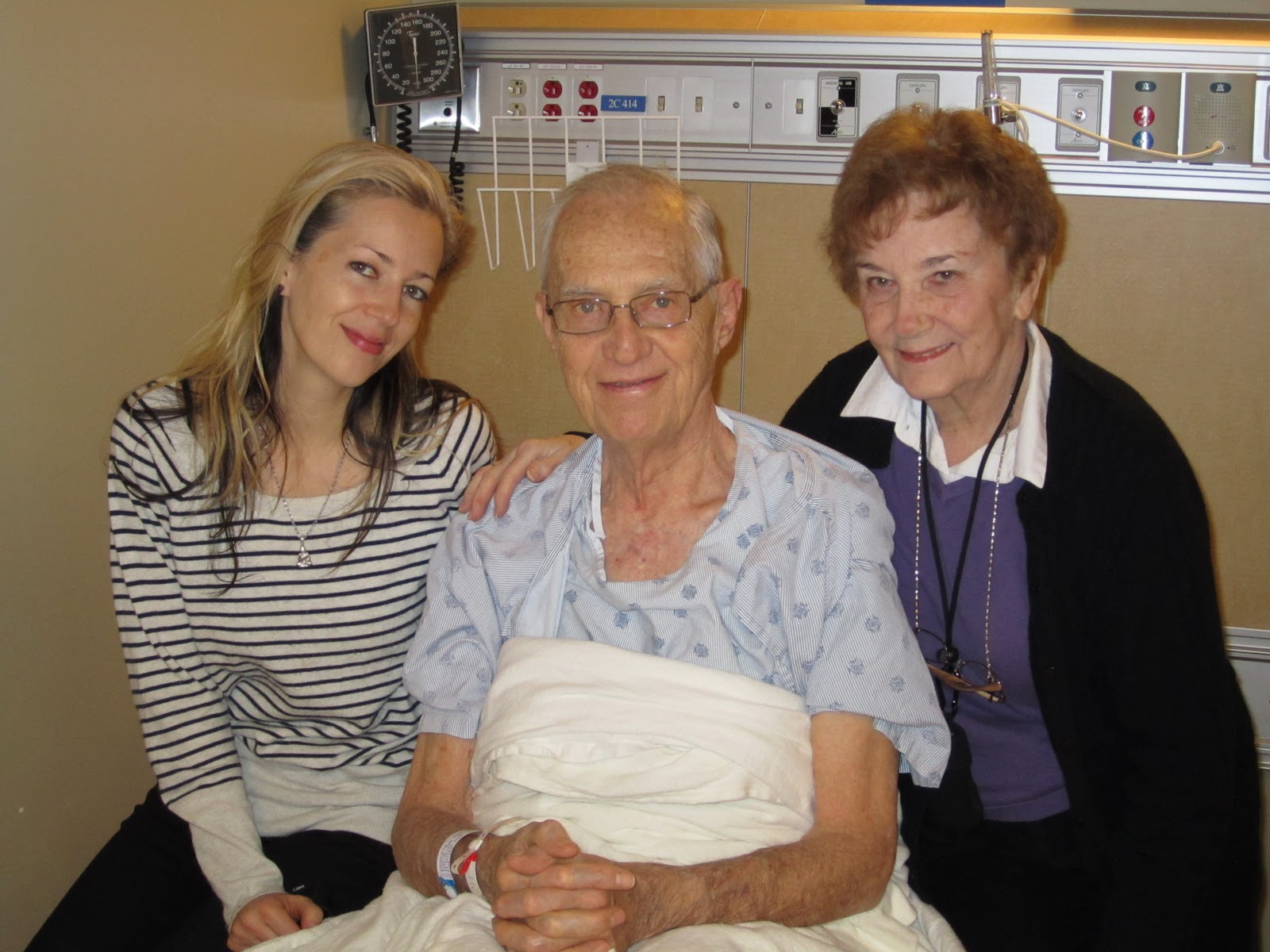
| The patient, centre, with friends & family celebrating his 80th birthday |
I had been attending university in Australia & returned home for the experimental surgery [which my dad was originally very reluctant to undergo but eventually agreed to]. On a Thursday, Dr. Cusimano asked my dad if he would prefer to have the surgery on the following Monday or Wednesday. My parents discussed it & opted for the Wednesday so my mother, brother & I could sadly attend my Uncle John's funeral on the Monday. Dr. Cusimano stated that he would do the procedure on the Wednesday provided my dad was still alive.
The Battista procedure was not a cure but rather a bridge to a transplant. There had been four previous patients at TGH who had had the Battista Procedure. Of the five in total, my dad is the only one still living. However, after the surgery he went back into heart failure about ten days afterwards and was added to the transplant list [breaking the age guideline]. Approximately six weeks later, my dad received his life-saving transplant...and the rest is history :D
More info on the Battista Procedure can be found here:
http://www.texheartsurgeons.com/LVRsurgery.htm
http://www.medicalreports.co.cc/2009/04/batista-surgery.html
http://www.theheart.org/article/292705.do
Friday, March 18, 2011
Pacer & C Difficile
Recently, my Dad [also a heart transplant recipient, 1997] had his pacemaker replaced. His was beginning to function poorly & he was updated with a smaller, more efficient model.
The procedure was day surgery done at Toronto General Hospital and was performed by Dr. Cusimano. He has operated on my Dad previously during his heart reduction [Batista procedure], transplant, and original pacemaker procedure. Just as with my brother, Dr. Cusimano marked my Dad with his initials prior to the surgery.
| The patient pre-op |
The procedure was day surgery done at Toronto General Hospital and was performed by Dr. Cusimano. He has operated on my Dad previously during his heart reduction [Batista procedure], transplant, and original pacemaker procedure. Just as with my brother, Dr. Cusimano marked my Dad with his initials prior to the surgery.
| RJC for RJ Cusimano, McBride family <3 surgeon |
Just after the procedure, my Dad was given one very large dose of antibiotics to prevent infection. Being a heart transplant patient, his family doctor normally follows up antibiotics with a medicine called Flagyl since the antibiotics wipe out both the good and bad bacteria. Oddly, he didn't receive the Flagyl this time. We suspect this is why he developed Clostridium Difficile. More to come on C Diff & his recent stay in isolation at Trillium Health Centre in Mississauga...
Friday, March 4, 2011
For Your Viewing Pleasure...
Our friend, Andrea Clegg, received her heart transplant in December, 2010. The Canadian news channel, Global, was there to film it. The segment called Heart to Heart will be aired tomorrow, Saturday, March 5th at 7 p.m. Check out http://www.globalnews.ca/programs/16x9/index.html for a teaser video. Warning: not for the faint of heart.
Post-transplant, Andrea is progressing well! She occasionally sees my brother or father at the biopsy clinic at Toronto General Hospital. Currently, she is focusing on operating and promoting the Life Donation Awareness Association of Midwest Ontario. She also maintains her blog stayingtruetomyheart.blogspot.com.
Monday, February 14, 2011
Happy Heart Day
I'm not one to go crazy over Valentine's Day. However, I have decided to leave you all with a classic "heart" photo! This is a photo of my brother, Michael's, two hearts. It was taken in the OR on Dr. Cusimano's camera [I'm frequently asked if I took the photo, which I did not] during his heart transplant surgery on October 27th, 2010. The hearts are being held over Michael's resting body. The heart on the left is Michael's original, enlarged heart. The one on the right is his new, donated heart. Michael's first comment after seeing this photograph was "there's no question that I needed the transplant".
Some details for those who are not sqeamish! Dr. Cusimano is holding the old heart with his thumb in the aorta. Also, the wire coming out of the old heart is the remnants of Michael's implanted defibrillator, which was removed during the transplant. The metal bar running along the bottom [near the gauze] is calleed a separator and is holding Michael's ribs open. The blood-filled tube running over the separator is redirecting Michael's blood to the heart-blood machine which oxygenatesd his blood during the surgery. The yellow on the new heart is fat. Our hearts need a healthy amount of fat on them.
Happy Valentine's day!!!
![]() |
| Michael's two hearts. |
Happy Valentine's day!!!
Thursday, February 10, 2011
Delivering the Gift Life
Subscribe to:
Posts (Atom)